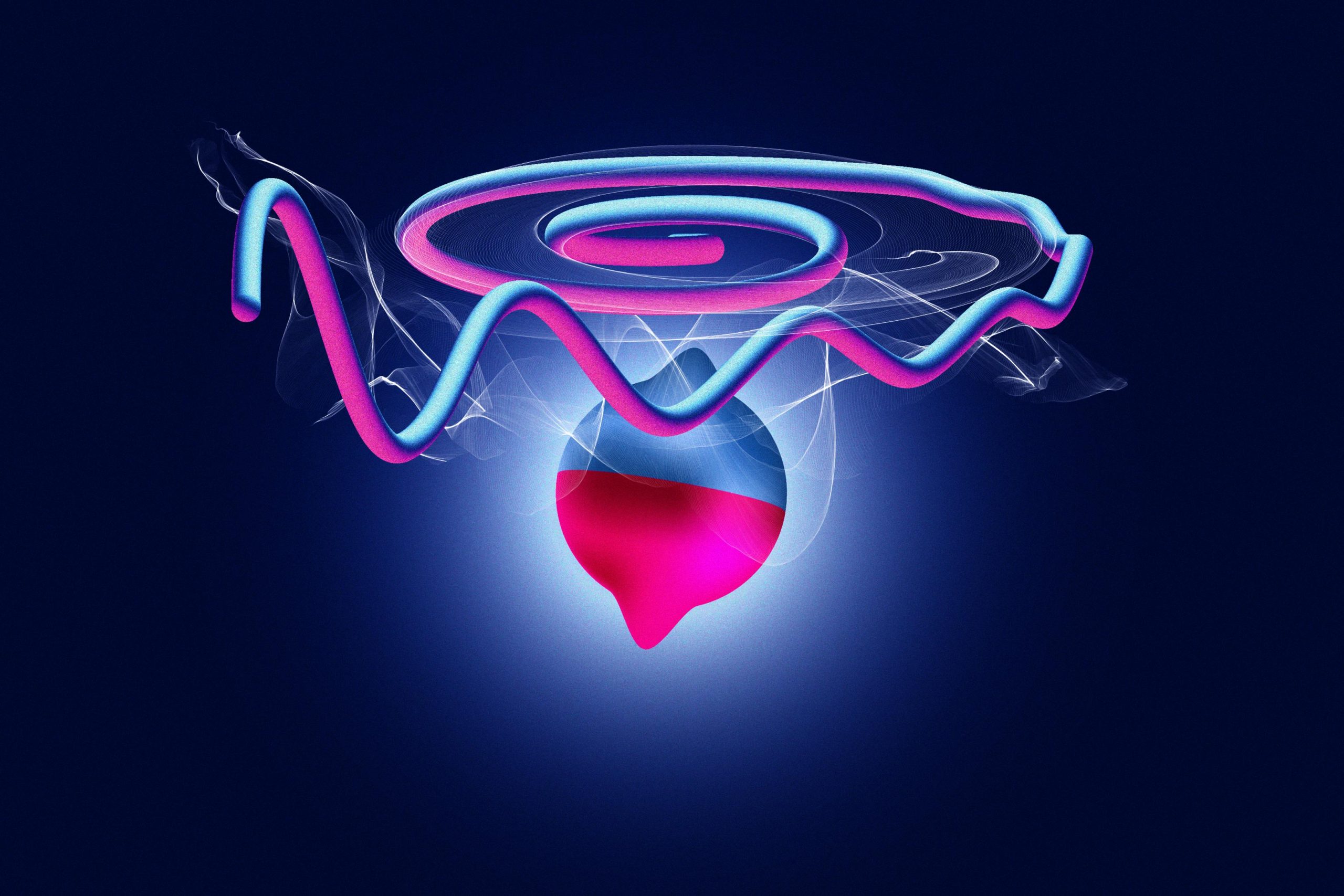
An international team of scientists has succeeded for the first time in observing the “nutation” of spins in magnetic materials (the vibrations of their axis during precession). The measured nutation period was on the order of a picosecond. The discovery was published by Nature Physics. Photo credit: Dunia Maccagni
Much of the “memory” of the world and all of our digital activities is based on media, hard drives, on which the information is encoded thanks to magnetism by directing the spin of the electrons in one direction or the other.
An international team of scientists led by the Italian physicist Stefano Bonetti, professor at Ca’Foscari University of Venice and Stockholm University, has succeeded for the first time in observing the “nutation” of these spins in magnetic materials, that is, their vibrations during the axis of precession. The measured nutation period was on the order of a picosecond: a thousandth of a billionth of a second. The discovery was recently published by Natural physics.
As with any rotating object, the axis of a spin nutation and precession, from gyroscopes to planets. In this study, physicists observed experimentally that the nutation of the magnetic spin axis is 1000 times faster than precession, a curiously similar ratio to that of Earth.
This new discovery of previously unknown physical properties of spins is of fundamental importance for research in order to make digital technologies ever faster, more compact and more energetically efficient. However, in order to manipulate these phenomena on timescales of thousandths of a billionth of a second, we must first know their dynamics, including inertial dynamics.

An international team of scientists has succeeded for the first time in observing the “nutation” of spins in magnetic materials (the oscillations of their axis during precession). The measured nutation period was on the order of a picosecond. The discovery was published by Nature Physics. Photo credit: Andrea Avezzù / Università Ca ‘Foscari Venezia
“This is the first direct and experimental proof of the inertial movements of magnetic spins,” explains Stefano Bonetti, who coordinates an ERC project on ultrafast magnetism, “with effects that affect data centers, for example, in which almost all of humanity’s digital information is stored Bits with the north pole up or down, which encodes the computer’s 0s and 1s. When these rotations are reversed to write information, precession and nutation also come into play. Knowing the nutation period becomes essential as the speed increases.
This first observation of these movements paves the way for new technologies to improve the efficiency of our digital activities, which have the highest increase in energy consumption of any human activity. ”
The experiment
The experiment required collaboration with several European scientific laboratories in Germany (Helmholtz Center Dresden-Rossendorf, Chemnitz University of Technology, Duisburg-Essen University, German Aerospace Center (DLR), TU Berlin) France (École Polytechnique) and Italy (Federico II University of Naples and Parthenope University of Naples), with the key measurement in the Helmholtz Research Center in Dresden -Rossendorf.
In this center, the TELBE laboratory can generate the intensive terahertz radiation (ie the frequency range between microwaves and infrared) required for the experiment. The group led by Stefano Bonetti was among the first to use this lab and helped develop the actual machine.
“The first experiments were challenging,” says the physicist from Ca ‘Foscari, “but after a few years the machine was already working at a very high output. These measurements were carried out on three different occasions over a year to check the reproducibility of this never before observed effect. ”
Stefano Bonetti’s activities are part of a wider investment context of the Venetian University of Scientific Research and Teaching of the Institute of Molecular Sciences and Nanosystems. From this academic year this department starts a course in technical physics, which is coordinated by Bonetti, himself a physics engineer: “Science is constantly evolving and who knows what we will research in ten years, but the idea of the new course the aim is to prepare exactly a new generation of scientists who are equipped for the challenges of the future. ”
Reference: “Inertial spindle dynamics in ferromagnets” by Kumar Neeraj, Nilesh Awari, Sergey Kovalev, Debanjan Polley, Nanna Zhou Hagström, Sri Sai Phani Kanth Arekapudi, Anna Semisalova, Kilian Lenz, Bertram Green, Jan-Christoph Deinert, Igor Ilyakov, Min Chen, Mohammed Bawatna, Valentino Scalera, Massimiliano d’Aquino, Claudio Serpico, Olav Hellwig, Jean-Eric Wegrowe, Michael Gensch and Stefano Bonetti, September 28, 2020, Natural physics.
DOI: 10.1038 / s41567-020-01040-y